Monday, November 22, 2021

Blockchain explanation

 Visual Capitalist has an outstanding graphical explanation of how blockchain works.


https://www.visualcapitalist.com/a-visual-guide-to-investing-in-the-blockchain-ecosystem/


A Visual Guide to Investing in the Blockchain Ecosystem

Many technologies are coined as “disruptive”, but only a select few can be considered transformational.

One such technology is blockchain, because it has the potential to permanently change our economic, legal, and political systems.

In this infographic from Global X, we provide an overview of the entire blockchain ecosystem, and look at some different ways investors can gain access to it.

Blockchain: A Decentralized Network

In its most basic sense, a blockchain is a type of database with several unique properties.

One of these is decentralization, which means no single party has control over the data. To see why this matters, consider a traditional database where users store their data on a central server. The server is ultimately controlled by a single entity with the authority to modify or delete data.

In the event that this authority is compromised, users of the database can be left at great risk. A blockchain, on the other hand, is distributed across many participants in a peer-to-peer network. This means that all users play a role in verifying the integrity of the database, as well as verifying new additions.

Furthermore, blockchains are designed with an append-only structure. This means that users can only A) search and retrieve data from the blockchain; and B) add more data onto the blockchain.

Blockchain Structure

A blockchain is made up of “blocks” which contain three items.

First, there’s the data itself. In the case of Bitcoin, this includes all of the relevant information for a given transaction such as date and quantity. Second is the block’s hash, a unique value that identifies the block and its contents.

For Bitcoin, a hash takes the form of a 64-digit hexadecimal number, though this can be different for other blockchains. The following table provides a simple example of how hashes are generated.

Input (the block’s data)Hash functionHash
Car-->AW94 42RZ 66TZ
The blue car was speeding-->85ZU I9Y2 RTH2
The red car was speeding-->5RT8 U1IY 148H

On any given blockchain, the hash values will share the same format. Modifying a block’s data will also result in an entirely different hash.

The third and final item is the hash of the previous block, and is what contributes to the “chain” part of blockchain. This feature makes it nearly impossible for someone to tamper with the blockchain’s data, because their copy of the chain would then conflict with all other users.

The Blockchain Ecosystem

Holding cryptocurrency is one way to gain exposure to blockchain, but as companies continue to study it, new use cases are emerging. Here’s an explanation of the four segments of the blockchain ecosystem.

1. Digital Asset Mining

Digital asset mining consists of companies that process transactions on blockchain ledgers, including Bitcoin. Processing transactions is known as “mining” because participants can receive cryptocurrency as compensation.

From an operations perspective, cryptominers are relatively simple when compared to other businesses. The following table lists the components a cryptominer needs.

ComponentDetails
Network infrastructureEquipment that allows a miner to connect to various blockchain networks.
Mining computersThese computers run 24/7 to update and verify blockchain ledgers.
Internet connectionCryptominers require an internet connection because blockchains are network-based.
HVACMining computers must be kept cool for optimal performance. Some miners will locate in colder parts of the world to minimize costs.
ElectricityElectricity is one of the biggest costs for a cryptominer. Many companies locate in countries where electricity is cheap.

Digital asset mining requires a significant amount of electricity and has sparked debate in recent years over its environmental impact.

2. Blockchain Hardware

Blockchain hardware consists of companies that produce blockchain-related equipment.

This includes graphic processing units (GPUs), which are used in computing applications such as rendering and animation. GPUs were not originally intended for blockchain use (and have been around for much longer), but their high processing speeds makes them suitable for mining.

Today, cryptominers are transitioning to application-specific integrated circuit (ASIC) chips that are solely designed for cryptomining. Using these chips is critical for maximizing hash rate and profitability.

3. Blockchain Transactions

The blockchain transactions category includes companies that operate digital asset trading platforms. The segment is quickly evolving as new and existing businesses enter the space.

Company (year founded)Blockchain Involvement
Visa (1958)Visa aims to make cryptocurrency more usable through its crypto-linked credit cards.
PayPal (1998)PayPal’s widely-used platform began offering cryptocurrency trading in 2020.
Square (2009)Square added Bitcoin trading to its Cash App platform in 2018.
Coinbase (2012)Coinbase is America’s largest crypto exchange with over 43 million retail users.

4. Blockchain Applications & Integration

This segment is the broadest of the four, and includes any software or service that uses blockchain.

In many cases, blockchain can be used to improve our existing industries. Consider IBM Food Trust, a blockchain designed to create a more efficient and sustainable food supply chain.

Blockchain can also be used for more ambitious projects, such as creating a metaverse. While still largely conceptual, a metaverse is a digital world which would be accessed via virtual reality. In it, people would be able to work, play, socialize, and consume media.

These virtual worlds would also need their own economies—something blockchain could play a big role in. It’s reported that several companies, including the recently-named Meta, are investing billions each year in metaverse development.

Introducing: The Global X Blockchain ETF

The Global X Blockchain ETF (Ticker: BKCH) seeks to provide investment results that correspond generally to the price and yield performance, before fees and expenses, of the Solactive Blockchain Index.

Segment of Solactive Blockchain IndexIndex Weight
Digital asset mining47.7%
Blockchain & digital asset transactions24.7%
Blockchain & digital asset hardware13.2%
Blockchain applications10.1%
Blockchain & digital asset integrations4.3%

Figures rounded. Source: Solactive AG, as of September 30th, 2021.

Investors can use this passively managed solution to gain diversified exposure to the blockchain ecosystem.

Thursday, November 18, 2021

House inside a Greenhouse

 Cool idea.

https://returntonow.net/2019/03/04/swedish-couple-builds-greenhouse-around-home-to-stay-warm-and-grow-food-all-year-long/

Swedish Couple Builds Greenhouse Around Home to Stay Warm and Grow Food All Year Long


Greenhouse keeps home in the 60’s, even when it’s freezing outside; allows family to grow Mediterranean fruit in Sweden

Marie Granmar and Charles Sacilotto literally live in a bubble, insulated from the cold and the harshness of the elements, while taking in the best of what nature has to offer.

Their house is built inside of a greenhouse, providing them free heat and free food in the winter.

In Stockholm, Sweden, where winter lasts 9 months out of the year, that’s a huge asset.

The average temperature in Stockholm in January is below freezing. But step into Marie and Charles’ bubbled-in “backyard,” and you’ll be much warmer.


Wednesday, June 9, 2021

Ocean energy

One of the most obvious sources of energy is the movement of the water in the oceans (mainly tidal). Earthtide has potential as well, but would be much more difficult to harness.

Marine energy includes waves, tides, and ocean temperature differentials. The entire human consumption of energy, worldwide is about 20-25,000 terrawatt-hours per year.

"There is the potential to develop 20,000–80,000 terawatt-hours per year (TWh/y) of electricity generated by changes in ocean temperatures, salt content, movements of tides, currents, waves and swells."

https://en.wikipedia.org/wiki/Marine_energy

In other words, the oceans could provide all the energy we ever need, if we can harness it.

_____

There are two major wave-energy installations in the world. One is in my second-favorite part of the world--Brittany, aka Bretagne, aka Finisterre, in France.

https://www.edf.fr/en/the-edf-group/industrial-provider/renewable-energies/marine-energy/tidal-power

The other is in Korea (also an awesome place).

But the newest one is in my favorite part of the world--the Oregon coast.

_____

I post this because right now, about a mile from where I live, an important research project focusing on marine energy is underway. Here's the link:

http://pacwaveenergy.org/south-test-site/

The next few years will tell if something significant comes out of this.


Friday, June 4, 2021

Commit to Quit

There is no single action that a person can take to improve the environment more important than quitting smoking. The destruction caused by smoking in terms of public health, individual health, wasted cropland, fires, and the smoke pollution itself is incalculable.

Memorial Day in the United States was also world "Commit to Quit" day. An article in China Daily explains it well.

http://global.chinadaily.com.cn/a/202105/31/WS60b43a29a31024ad0bac2712.html

It's time to commit to quitting tobacco

By Judith Mackay | China Daily Global | Updated: 2021-05-31 09:21
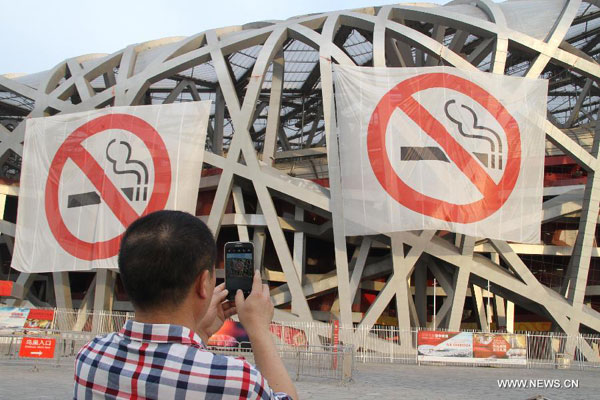
File photo: Non-smoking banners are displayed on the iconic Bird's Nest National Stadium in Beijing. [Photo/Xinhua]

To celebrate World No Tobacco Day on Monday, the World Health Organization has chosen "Commit to Quit" smoking as this year's theme.

On its website, the WHO provides more than 100 positive reasons for quitting as well as guidelines to help smokers quit, but it also warns that new tobacco products such as electronic cigarettes and heated tobacco products are not the answer when attempting to quit smoking.

According to the WHO: "The benefits of quitting tobacco are almost immediate. After just 20 minutes of quitting smoking, your heart rate drops. Within 12 hours, the carbon monoxide level in your blood drops to normal. Within two to 12 weeks, your circulation improves and lung function increases. Within one to nine months, coughing and shortness of breath decrease. Within five to 15 years, your stroke risk is reduced to that of a nonsmoker. Within 10 years, your lung cancer death rate is about half that of a smoker. Within 15 years, your risk of heart disease is that of a nonsmoker."

You are never too old to quit smoking and thus improve your health. For example, if you quit at the age of 50, you could gain six years of life expectancy.

Tobacco causes 8 million deaths worldwide each year. About one in every three cigarettes smoked in the world is smoked on the Chinese mainland, causing about 2 million deaths each year. This makes help in quitting imperative.

After evidence was published that smokers were more likely to develop severe disease and die from COVID-19 compared with nonsmokers, millions of smokers have wanted to quit tobacco.

There are a lot of other reasons to quit, too. Tobacco is addictive, harms almost every part of your body, and eventually kills an estimated half of its users.

Tobacco use is responsible for 25 percent of all cancer deaths globally. Tobacco causes more than 20 types of cancer, and smokers are up to 22 times more likely to develop lung cancer than nonsmokers.

One in five tobacco smokers will develop chronic obstructive pulmonary disease in their lifetime, especially people who start smoking during their childhood and teenage years.

Smoking can exacerbate asthma, restricting activity, contributing to disability and increasing the risk of severe asthma attacks requiring emergency care. Tobacco also worsens tuberculosis.

Tobacco breaks hearts: Just a few cigarettes a day, occasional smoking, or exposure to secondhand smoke increases the risk of heart disease. Tobacco smokers have up to twice the risk of a stroke and a fourfold increase in heart disease risk.

Smokers are also dangerous to others, especially at home and at the workplace. Smoking or using e-cigarettes around children compromises their health and safety. Smoking is extremely hazardous to an unborn child.

There are many other reasons to quit. For example, it's expensive; you could be spending your money on more important things.

Tobacco pollutes the environment. Arsenic, lead, nicotine, formaldehyde and other toxic substances have been identified in discarded cigarette butts, which leach into the soil and the oceans.

The WHO warns bluntly: "When you buy tobacco, you are financially supporting an industry that exploits farmers and children and peddles sickness and death."

The WHO also clearly states that all forms of tobacco use are deadly, and notes specifically that e-cigarettes and heated tobacco products are harmful to health. However, the tobacco industry is pushing the new products as the answer to cessation.

In contrast, the WHO highlights the "addictive potential" of these new products and recommends measures against e-cigarettes and heated tobacco products. The WHO says that heated tobacco products "expose users to toxic emissions similar to those found in cigarette smoke, many of which can cause cancer". Switching from conventional tobacco products to such products does not equal quitting.

Low- and middle-income countries in particular are struggling to reduce cigarette smoking. More than 40 countries and jurisdictions have already banned e-cigarettes.

World No Tobacco Day offers a fitting opportunity to "commit to quit" use of all tobacco products, and to improve our entire community's health and air quality. Let's pull together to make it happen.

The author is a senior policy adviser to the World Health Organization, a special adviser to the Global Centre for Good Governance in Tobacco Control, and director of the Asian Consultancy on Tobacco Control.

Thursday, May 6, 2021

Commodities and "green" economies

The shift to "green" will cause expansion of mining, particularly for copper and rare earths.

https://www.zerohedge.com/markets/doh-moment-micro-chips

Meanwhile, there is no shortage of analysts calling for the beginning of a new global commodities Supercycle. These occur when something fundamental happens that resets global demand for raw materials. Commodities analysts have successfully called 16 of the 4 historical supercycles… (ahem…)

In the case of copper, which is up to near $10k from $4300 a year ago, it’s the (re)-electrification of the economy that matters as nations seek to rebuild state power-grid infrastructure to enable EV charging and to facilitate unreliable renewable power sources. Grids built in the 1930s simply we’re designed for the digital and home-charging age.

You can’t have electric on tap without copper pipes! While the average internal combustion engine car has some 27 kg of copper, EVs apparently require 87 kg. It’s no wonder banks like Goldman predict new record prices are coming as EV demand goes stratospheric, we have to rebuild the electric supply network, and that then triggers a host of other supply blips from platinum, lithium and even gold old Iron ore, at which point I shall simply remind you:Perversely, the climate-change emergency and the need to swiftly green the planet is perhaps the best ever argument to invest in mining. There is nothing we can make on this planet that doesn’t first demand we hew the materials out the ground.

Every offshore wind-turbine requires some 450 tonnes of Steel, which requires an enormous amount of metallurgical coal to produce… and the UK government, in its infinite wisdom, just put the only UK source of met coal – the new West Cumbria mine – on hold so it wouldn’t be embarrassed at the COP26 climate conference in the Autumn. D’oh!

Global Supply Chains, Semiconductors and the New Commodities Supercycle – all things to be thinking about….

Monday, May 3, 2021

Germany's renewables experiment is over.

Nuclear is the principal energy option for the future.


Germany’s renewables experiment is over. By 2025 it will have spent $580B to make electricity nearly 2x more expensive & 10x more carbon-intensive than France’s. The reason renewables can’t power modern civilization is because they were never meant to.


Over the last decade, journalists have held up Germany’s renewables energy transition, the Energiewende, as an environmental model for the world. 

“Many poor countries, once intent on building coal-fired power plants to bring electricity to their people, are discussing whether they might leapfrog the fossil age and build clean grids from the outset,” thanks to the Energiewendewrote New York Times reporter in 2014.

With Germany as inspiration, the United Nations and World Bank poured billions into renewables like wind, solar, and hydro in developing nations like Kenya.

But then, last year, Germany was forced to acknowledge that it had to delay its phase-out of coal, and would not meet its 2020 greenhouse gas reduction commitments. It announced plans to bulldoze an ancient church and forest in order to get at the coal underneath it.

After renewables investors and advocates, including Al Gore and Greenpeace, criticized Germany, journalists came to the country’s defense. “Germany has fallen short of its emission targets in part because its targets were so ambitious,” one of them argued last summer.

“If the rest of the world made just half Germany’s effort, the future for our planet would look less bleak,” she wrote. “So Germany, don’t give up. And also: Thank you.”

But Germany didn’t just fall short of its climate targets. Its emissions have flat-lined since 2009.

Now comes a major article in the country’s largest newsweekly magazine, Der Spiegel, titled, “A Botched Job in Germany” ("Murks in Germany"). The magazine’s cover shows broken wind turbines and incomplete electrical transmission towers against a dark silhouette of Berlin.

“The Energiewende — the biggest political project since reunification — threatens to fail,” write Der Spiegel’s Frank Dohmen, Alexander Jung, Stefan Schultz, Gerald Traufetter in their a 5,700-word investigative story.

Over the past five years alone, the Energiewende has cost Germany €32 billion ($36 billion) annually, and opposition to renewables is growing in the German countryside.

“The politicians fear citizen resistance” Der Spiegel reports. “There is hardly a wind energy project that is not fought.”

In response, politicians sometimes order “electrical lines be buried underground but that is many times more expensive and takes years longer.”

As a result, the deployment of renewables and related transmission lines is slowing rapidly. Less than half as many wind turbines (743) were installed in 2018 as were installed in 2017, and just 30 kilometers of new transmission were added in 2017.

Solar and wind advocates say cheaper solar panels and wind turbines will make the future growth in renewables cheaper than past growth but there are reasons to believe the opposite will be the case.

Der Spiegel cites a recent estimate that it would cost Germany “€3.4 trillion ($3.8 trillion),” or seven times more than it spent from 2000 to 2025, to increase solar and wind three to five-fold by 2050.

Between 2000 and 2019, Germany grew renewables from 7% to 35% of its electricity. And as much of Germany's renewable electricity comes from biomass, which scientists view as polluting and environmentally degrading, as from solar.

Of the 7,700 new kilometers of transmission lines needed, only 8% have been built, while large-scale electricity storage remains inefficient and expensive. “A large part of the energy used is lost,” the reporters note of a much-hyped hydrogen gas project, “and the efficiency is below 40%... No viable business model can be developed from this.”

Meanwhile, the 20-year subsidies granted to wind, solar, and biogas since 2000 will start coming to an end next year. “The wind power boom is over,” Der Spiegel concludes.

All of which raises a question: if renewables can’t cheaply power Germany, one of the richest and most technologically advanced countries in the world, how could a developing nation like Kenya ever expect them to allow it to “leapfrog” fossil fuels?

The Question of Technology

The earliest and most sophisticated 20th Century case for renewables came from a German who is widely considered the most influential philosopher of the 20th Century, Martin Heidegger.

In his 1954 essay, “The Question Concerning of Technology,” Heidegger condemned the view of nature as a mere resource for human consumption.

The use of “modern technology,” he wrote, “puts to nature the unreasonable demand that it supply energy which can be extracted and stored as such… Air is now set upon to yield nitrogen, the earth to yield ore, ore to yield uranium…to yield atomic energy.”

The solution, Heidegger argued, was to yoke human society and its economy to unreliable energy flows. He even condemned hydro-electric dams, for dominating the natural environment, and praised windmills because they “do not unlock energy in order to store it.”

These weren’t just aesthetic preferences. Windmills have traditionally been useful to farmers whereas large dams have allowed poor agrarian societies to industrialize.

In the US, Heidegger’s views were picked up by renewable energy advocates. Barry Commoner in 1969 argued that a transition to renewables was needed to bring modern civilization "into harmony with the ecosphere."

The goal of renewables was to turn modern industrial societies back into agrarian ones, argued Murray Bookchin in his 1962 book, Our Synthetic Environment.

Bookchin admitted his proposal "conjures up an image of cultural isolation and social stagnation, of a journey backward in history to the agrarian societies of the medieval and ancient worlds."

But then, starting around the year 2000, renewables started to gain a high-tech luster. Governments and private investors poured $2 trillion into solar and wind and related infrastructure, creating the impression that renewables were profitable aside from subsidies.

Entrepreneurs like Elon Musk proclaimed that a rich, high-energy civilization could be powered by cheap solar panels and electric cars.

Journalists reported breathlessly on the cost declines in batteries, imagining a tipping point at which conventional electricity utilities would be “disrupted.”

But no amount of marketing could change the poor physics of resource-intensive and land-intensive renewables. Solar farms take 450 times more land than nuclear plants, and wind farms take 700 times more land than natural gas wells, to produce the same amount of energy.

Efforts to export the Energiewende to developing nations may prove even more devastating.

The new wind farm in Kenya, inspired and financed by Germany and other well-meaning Western nations, is located on a major flight path of migratory birds. Scientists say it will kill hundreds of endangered eagles.

“It’s one of the three worst sites for a wind farm that I’ve seen in Africa in terms of its potential to kill threatened birds,” a biologist explained.

In response, the wind farm’s developers have done what Europeans have long done in Africa, which is to hire the organizations, which ostensibly represent the doomed eagles and communities, to collaborate rather than fight the project.

Kenya won't be able to “leapfrog” fossil fuels with its wind farm. On the contrary, all of that unreliable wind energy is likely to increase the price of electricity and make Kenya’s slow climb out of poverty even slower.

Heidegger, like much of the conservation movement, would have hated what the Energiewende has become: an excuse for the destruction of natural landscapes and local communities.

Opposition to renewables comes from the country peoples that Heidegger idolized as more authentic and “grounded” than urbane cosmopolitan elites who fetishize their solar roofs and Teslas as signs of virtue.

Germans, who will have spent $580 billion on renewables and related infrastructure by 2025, express great pride in the Energiewende. “It’s our gift to the world,” a renewables advocate told The Times.

Tragically, many Germans appear to have believed that the billions they spent on renewables would redeem them. “Germans would then at last feel that they have gone from being world-destroyers in the 20th century to world-saviors in the 21st,” noted a reporter.

Many Germans will, like Der Spiegel, claim the renewables transition was merely “botched,” but it wasn't. The transition to renewables was doomed because modern industrial people, no matter how Romantic they are, do not want to return to pre-modern life.

The reason renewables can’t power modern civilization is because they were never meant to. One interesting question is why anybody ever thought they could.  

Follow me on TwitterCheck out my website or some of my other work here

Michael Shellenberger is the best-selling author of Apocalypse Never: Why Environmental Alarmism Hurts Us All (Harper Collins), a Time Magazine “Hero of the Environment,”

Sun-driven climate

  Electroverse @Electroversenet Astrophysicist Dr Willie Soon says the climate is driven overwhelmingly by the sun, not by human carbon diox...