Lots of people have debunked the ridiculous article that came up with the statistic, but Richard Tol has summarized the problems better than anyone, so I'm reproducing his blog post here for archiving purposes:
Now almost two years old, John Cook’s 97% consensus paper has been a runaway success. Downloaded over300,000 times, voted the best 2013 paper in Environmental Research Letters, frequently cited by peers and politiciansfrom around the world, with a dedicated column in the Guardian, the paper seems to be the definitive proof that the science of climate change is settled.
It isn’t.
Consensus has no place in science. Academics agree on lots of things, but that does not make them true. Even so, agreement that climate change is real and human-caused does not tell us anything about how the risks of climate change weigh against the risks of climate policy. But in our age of pseudo-Enlightenment, having 97% of researchers on your side is a powerful rhetoric for marginalizing political opponents. All politics ends in failure, however. Chances are the opposition will gain power well before the climate problem is solved. Polarization works in the short run, but is counterproductive in the long run.
In their paper, Cook and colleagues argue that 97% of the relevant academic literature endorses that humans have contributed to observed climate change. This is unremarkable. It follows immediately from the 19th century research by Fourier, Tyndall and Arrhenius. In popular discourse, however, Cook’s finding is often misrepresented. The 97% refers to the number of papers, rather than the number of scientists. The alleged consensus is about any human role in climate change, rather than a dominant role, and it is about climate change rather than the dangers it might pose.
Although there are large areas of substantive agreement, climate science is far from settled. Witness the dozens of alternative explanations of the current, 18 year long pause in warming of the surface atmosphere. The debate on the seriousness of climate change or what to do about it ranges even more widely.
The Cook paper is remarkable for its quality, though. Cook and colleagues studied some 12,000 papers, but did not check whether their sample is representative for the scientific literature. It isn’t. Their conclusions are about the papers they happened to look at, rather than about the literature. Attempts to replicate their sample failed: A number of papers that should have been analysed were not, for no apparent reason.
The sample was padded with irrelevant papers. An article about TV coverage on global warming was taken as evidence for global warming. In fact, about three-quarters of the papers counted as endorsements had nothing to say about the subject matter.
Cook enlisted a small group of environmental activists to rate the claims made by the selected papers. Cook claims that the ratings were done independently, but the raters freely discussed their work. There are systematic differencesbetween the raters. Reading the same abstracts, the raters reached remarkably different conclusions – and some raters all too often erred in the same direction. Cook’s hand-picked raters disagreed what a paper was about 33% of the time. In 63% of cases, they disagreed about the message of a paper with the authors of that paper.
The paper’s reviewers did not pick up on these things. The editor even praised the authors for the “excellent data quality” even though neither he nor the referees had had the opportunity to check the data. Then again, that same editor thinks that climate change is like the rise of Nazi Germany. Two years after publication, Cook admitted that data quality is indeed low.
Requests for the data were met with evasion and foot-dragging, a clear breach of the publisher’s policy on validation and reproduction, yet defended by an editorial board member of the journal as “exemplary scientific conduct”.
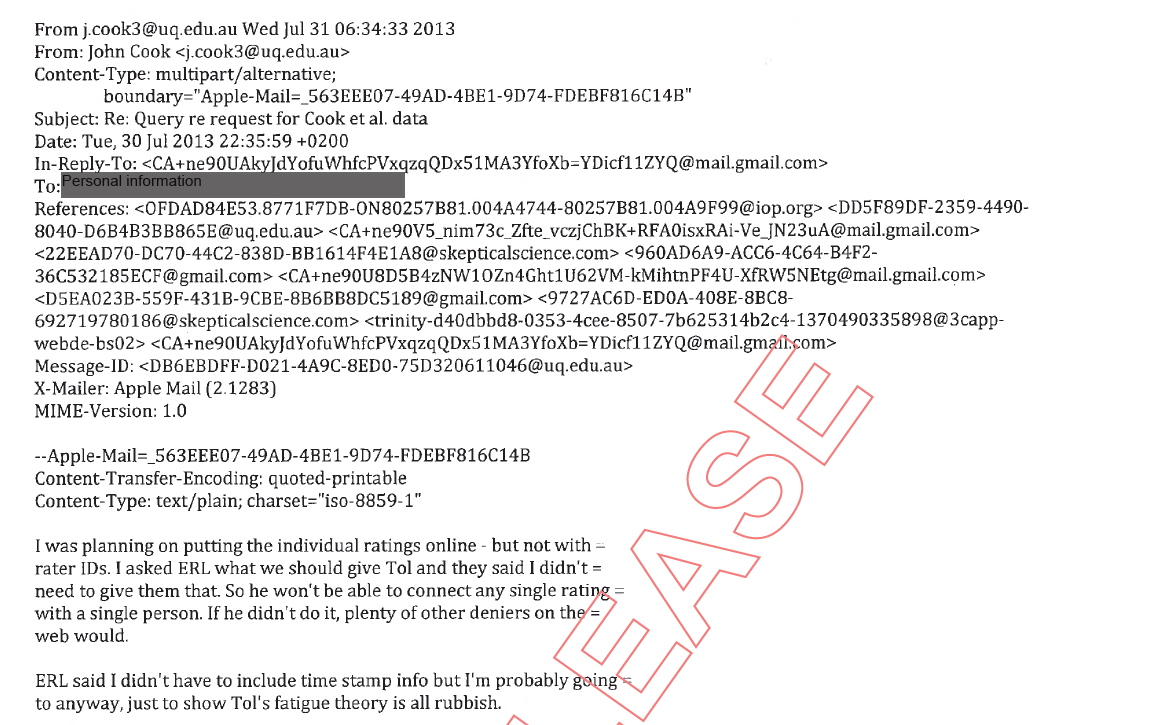
Cook hoped to hold back some data, but his internet security is on par with his statistical skills, and the alleged hacker was not intimidated by the University of Queensland’s legal threats. Cook’s employer argued that releasing rater identities would violate a confidentiality agreement. That agreement does not exist.
Cook first argued that releasing time stamps would serve no scientific purpose. This is odd. Cook’s raters essentially filled out a giant questionnaire. Survey researchers routinely collect time stamps, and so did Cook. Interviewees sometimes tire and rush through the last questions. Time stamps reveal that.
Cook later argued that time stamps were never collected. They were. They show that one of Cook’s raters inspected675 abstracts within 72 hours, a superhuman effort.
The time stamps also reveal something far more serious. After collecting data for 8 weeks, there were 4 weeks of data analysis, followed by 3 more weeks of data collection. The same people collected and analysed the data. After more analysis, the paper classification scheme was changed and yet more data collected.
Cook thus broke a key rule of scientific data collection: Observations should never follow from the conclusions. Medical tests are double-blind for good reason. You cannot change how to collect data, and how much, after having seen the results.
Cook’s team may, perhaps unwittingly, have worked towards a given conclusion. And indeed, the observations are different, significantly and materially, between the three phases of data collection. The entire study should therefore be dismissed.
This would have been an amusing how-not-to tale for our students. But Cook’s is one of the most influential papers of recent years. The paper was vigorously defended by the University of Queensland (Cook’s employer) and the editors of Environmental Research Letters, with the Institute of Physics (the publisher) looking on in silence. Incompetence was compounded by cover-up and complacency.
Climate change is one of the defining issues of our times. We have one uncontrolled, poorly observed experiment. We cannot observe the future. Climate change and policy are too complex for a single person to understand. Climate policy is about choosing one future over another. That choice can only be informed by the judgement of experts – and we must have confidence in their learning and trust their intentions.
An edited version appeared in the Australian on March 24, 2015

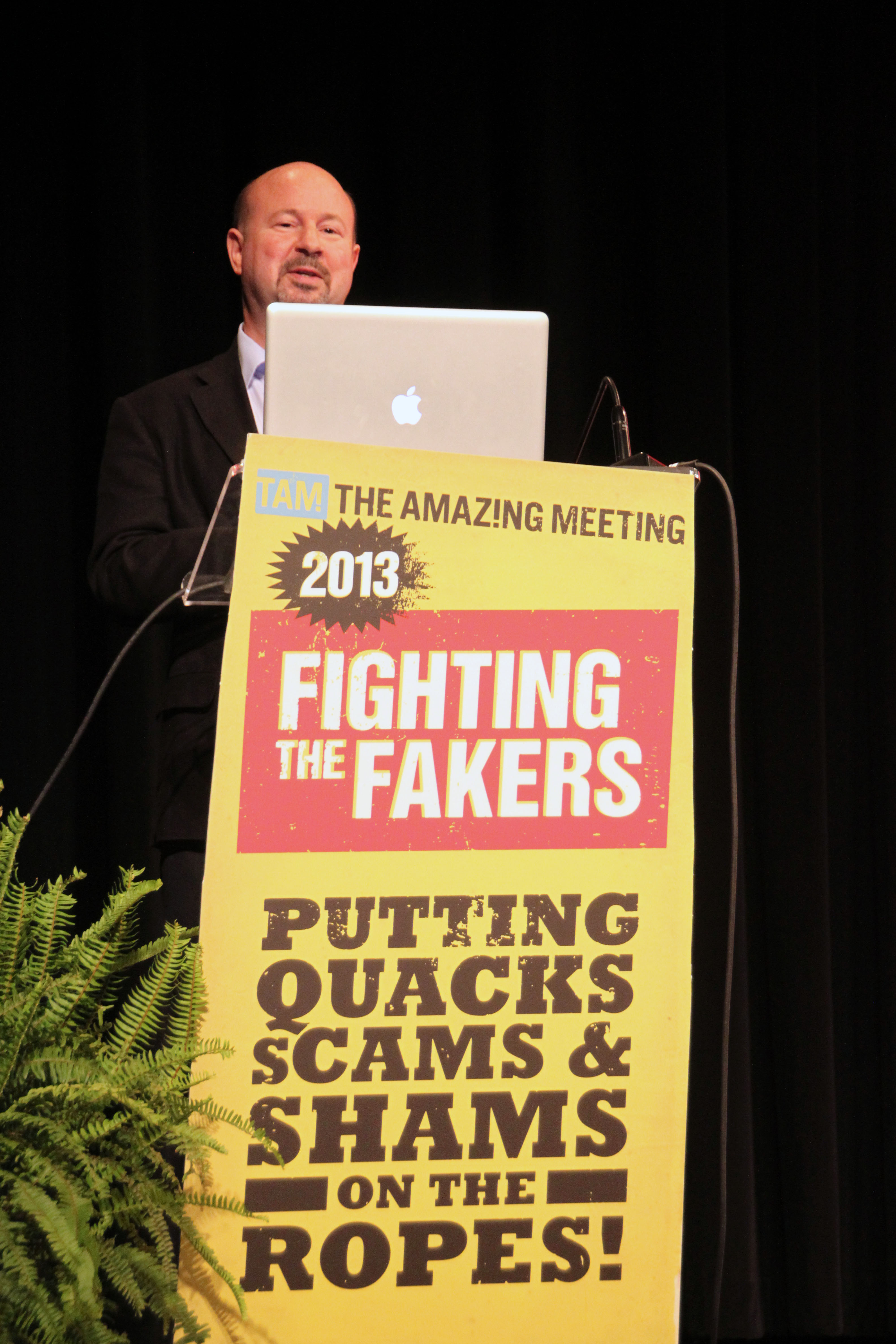 Michael Mann denies the pause in global warming: